
The Frozen Portfolio: Why an Annual Plan Commits Your Constraint on the Least Information You Will Ever Have
In February, someone in your organisation will find a genuinely good piece of work. A regulator will publish something that opens a window. A competitor will withdraw from a segment. A supplier will offer terms that expire in the spring. An operations manager will spot a fix worth more per week than anything currently in flight. Whoever finds it will do the responsible thing: write it up, cost it, and bring it to the portfolio process.
And the portfolio process will explain, politely and correctly, that this year's plan was agreed in October, that there is no capacity to allocate because all of it was allocated then, and that the right thing to do is submit the idea into the autumn round for consideration next year.
Nobody in that exchange has behaved badly. The planning team is protecting a plan the board approved. The finance partner is protecting a budget that has been committed. The delivery leads are protecting teams that are already fully loaded. Every actor is doing their job, and the aggregate result is that the best available piece of work in the portfolio waits eleven months for permission to exist. I want to give the condition a name, because it is invisible from the inside and it looks exactly like discipline: the frozen portfolio. A portfolio whose constrained capacity is committed in one annual event and cannot be recommitted until the next one.
An annual plan is a batch, and it is the largest one you have
We already accept, in this field, that batch size is an economic choice rather than an administrative detail. A large project ties up the constraint for longer, hides its problems until the end, and returns nothing until it finishes, which is the argument for smaller projects. Everything in that argument is about a batch of work. The same arithmetic applies, without modification, to a batch of decisions.
Look at what an annual planning round actually is. Somewhere between twenty and two hundred investment decisions, taken in a single event, on a single day's information, and then locked together as one commitment. It has every property that makes a large batch expensive. Anything that misses the batch waits for the next one. The information inside the batch ages while the batch is in force. Errors in the batch are not discovered item by item, they surface at the end of the period as a variance conversation. And because the whole thing was approved as a single artefact, changing one item feels like reopening all of them, which is why almost nobody does.
There is a second property that makes this batch worse than a large project, and it is the one that gets missed. The annual plan is not really a decision about money. Money is fungible, and a mis-allocated pound can be moved in a morning. The annual plan is a decision about capacity, and specifically about the capacity of the one resource that sets your delivery speed. Once October has assigned the integration team's year to fourteen named projects, those hours are not a budget line that can be journalled somewhere else. They are a queue. The commitment is far stickier than the spreadsheet suggests, because unwinding it means telling a sponsor that work they were promised is stopping, and that conversation is one almost no governance forum is designed to have.
The plan is built on the least information you will ever have
Every ranking in a portfolio rests on two estimates: what a piece of work is worth, and what it will consume. For work that has not started, both are at their least reliable. That is not a criticism of anyone's estimating, it is the nature of the thing. Value assumptions have not met a customer yet. Effort assumptions have not met the codebase, the supplier, or the data quality yet.
So consider what an annual cycle does with that fact. It constructs the entire allocation at the moment of maximum uncertainty, and then holds it fixed through precisely the period during which the uncertainty resolves. By March you know more about the top three items than you did in October. By June you know which business case was optimistic. By September you know which project has turned, in the sense of the return on its remaining investment no longer justifying the capacity it is eating. And in most portfolios, none of that improved knowledge can move a single constrained hour, because the hours were assigned before any of it existed.
Put a number on the staleness and it stops sounding abstract. If the ranking is refreshed once a year, the average age of the information your constraint is working from is about six months. In the eleventh month, your scarcest resource is executing a priority order built on estimates that are fourteen months old, competing against opportunities it is not allowed to see. The plan was not wrong when it was written. It was right in October, and it expired somewhere around February, and it stayed in force until December.
An idea that arrives in February waits until January
The freeze also creates a queue, and the queue has arithmetic you can do on the back of an envelope. If proposals arrive more or less evenly through the year, and there is one funding event a year, then an idea waits on average half a cycle just to be considered: twenty-six weeks. Move to quarterly funding events and the same average wait is six and a half weeks. Move to monthly and it is about two.
That wait sits entirely before the work begins. It is not queueing for the constraint, and it is not the decision latency that accumulates inside a governance cycle once a paper is in the system. It is a queue in front of the front door, and it is additive to both. All the while, whatever the idea was worth is running its meter: value not yet arriving is drag cost accruing, whether or not anyone has opened a project code to record it.
The annual window also deforms the proposals themselves, in two ways worth naming because both get misdiagnosed as poor discipline. Because there is only one chance a year to ask, people ask for everything they might conceivably need for twelve months, so proposals arrive padded with optionality that would never survive a quarterly ask. And because missing the window costs a year, proposals are submitted whether or not they are ready, which is the exact opposite of the full kit principle: the cycle rewards being in the round over being ready to run. A portfolio with an annual intake will reliably fill its plan with over-scoped, under-baked work and then conclude that its business cases need a stricter template. The template is not the problem. The cadence is.
What the freeze costs: a worked example
Numbers make this concrete. They are illustrative, not exact, and the shape is what matters.
Your constraint is a systems integration team with about 1,800 hours a year available for project work once leave, support and advisory demand are honestly deducted. In October, the planning round allocates all 1,800 of those hours across fourteen approved projects. Ranked by what each returns per constrained hour, in the sense of value per constrained resource hour, the top of the plan sits around £1,800 an hour and the bottom around £300 an hour. The bottom items were approved because there was room and because they had sponsors, which is how most plans are actually filled.
In February the regulatory change lands. The opportunity it opens needs 250 integration hours and is worth about £550,000 in the first year, which is a return of £2,200 per constrained hour, well above anything in the approved plan.
Under an annual cycle, that opportunity cannot enter until next January, so it starts eleven months later. A year of benefit deferred by a year is, in present value terms, a year of benefit you never collect. Call it £500,000 that simply does not happen, and note that this assumes the window is still open in January, which for a regulatory or competitive opening is a generous assumption.
Under a cycle that can reallocate quarterly, the same opportunity enters in April. It takes its 250 hours from the bottom of the plan, displacing work returning £300 an hour. The arithmetic of the swap is: 250 hours at £2,200 is £550,000 of value in, against 250 hours at £300, or £75,000, of value deferred out. The displaced work is not cancelled, it returns to the queue and gets done when it earns the position. So the net gain is roughly £475,000, captured nine months sooner than the frozen portfolio could have captured it.
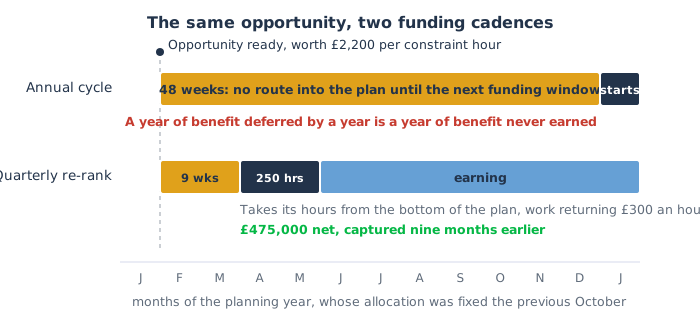
Nearly half a million pounds, from one decision, in a portfolio whose constraint has 1,800 hours to give. And most portfolios do not get one such shift a year, they get two or three. The striking thing is that no additional capacity was required to capture it, no team worked harder, and no project was cancelled. The only thing that changed was how often the organisation is permitted to reconsider where its scarcest hours go.
One honest caveat, because it matters for what you do next. That £475,000 is only real if the displaced work can actually be stopped. If your governance cannot take 250 hours away from a sponsor mid-year, the reallocation is arithmetic on paper and nothing moves. The freeze is rarely enforced by the calendar. It is enforced by the absence of a stop.
Three decisions, three cadences, one meeting
Here is the diagnosis underneath all of this, and it is more precise than "annual planning is bad". Your annual round is making three genuinely different decisions at once, and they have three different natural rhythms.
The first is how much the portfolio may spend. An annual envelope is the right answer here. It is what the board approves, what finance reports, what external commitments are built on, and there is nothing in flow economics that argues against it.
The second is which work is worth doing, in what order. The natural cadence for that decision is set by how fast the information behind it changes, and in most organisations that is considerably faster than once a year. Quarterly is a defensible floor.
The third is which work starts now. That decision should not be on a cadence at all. It should be a pull: work starts when the constraint has capacity to run it and the work is ready to be run, which is what a work in progress limit exists to enforce.
Collapse all three into one meeting and the slowest of them wins. The annual rhythm, which is correct for the money, is imposed on a ranking that needed refreshing and on a release decision that needed to be continuous. That is the whole defect, stated as compactly as I can manage. The problem was never the fiscal year. It was the coupling.
Why single-project management is structurally blind to this
If the cost is this large, why is it not on a report? Because the frame most portfolios manage in has no place to record it.
Managed as a set of independent projects, every project is measured against its own approved baseline: is it on time, on budget, delivering its stated scope. That test is entirely internal to the project. It cannot ask whether this project should still be consuming the constraint at all, because the alternative use of those hours is not a fact about this project, it is a fact about the portfolio. And the plan as a whole is measured by adherence, by whether the organisation delivered in December what it promised in January. So a portfolio that executed October's ranking flawlessly for twelve months scores full marks, while having spent its scarcest resource on the second-best available work for ten of them. There is no variance line anywhere in management reporting called "value we could have had instead", which means the single largest cost of the freeze is, by construction, unbookable.
This is the Project Illusion operating at the level of the planning calendar. Every project can be green, every governance step properly minuted, every pound spent as approved, and the portfolio can still have missed the best thing available to it for most of the year, because what was optimised was fidelity to a plan rather than the return on a constraint. Plan adherence and portfolio performance are different quantities, and an annual cycle makes them look like the same one.
There is a quieter cost too, and it compounds. The person who found the February opportunity learns that there is no route in. So does everyone who watches what happens to them. Within a couple of cycles, the organisation stops surfacing mid-year opportunities altogether, the intake pipeline goes quiet between rounds, and the freeze acquires the best possible evidence in its own defence: nothing much arrives mid-year, so why would we need to reallocate. A frozen portfolio eventually stops being told what it is missing.
What to do instead
None of what follows requires abandoning your budget cycle. It requires separating the three decisions that cycle has bundled.
1. Approve an envelope, not a list. Let the annual round set the total capacity and spend available to the portfolio, and let it name only the commitments that genuinely need twelve-month certainty, such as long-lead capital and regulatory programmes. Everything else is a ranked candidate list, not a promise. This is a smaller change to your paperwork than it sounds and a very large change to your options.
2. Commit one quarter of the constraint, indicate the rest. Draw a hard line in the plan between hours that are committed, meaning work that will start and will not be interrupted, and hours that are indicated, meaning intended but re-decidable. Sponsors can be told honestly which side of the line they are on. Most of the political heat in reallocation comes from having implied that everything was committed when only the first quarter ever was.
3. Hold back a reallocation reserve. Leave fifteen to twenty percent of constrained capacity unallocated in the annual round, explicitly reserved for work that does not exist yet. This is the recommendation that gets the most resistance and it needs the least defending: a plan that allocates one hundred percent of the constraint in October has priced next year's best opportunity at zero. It has also, incidentally, loaded the constraint to full, which is the utilisation trap in its most consequential form.
4. Run a standing intake with a standard price tag. Any proposal, any week, sized in constrained-resource hours and quoted with its cost of delay, entering a ranked queue rather than a mailbox. What makes this work is that the queue is ranked by return on the constrained resource and that every new entry is priced against what it displaces, which is the price of yes applied to reallocation rather than to addition.
5. Re-rank quarterly, and give the re-rank the authority to stop things. A quarterly review that can only add is not a re-rank, it is a scope ratchet with a calendar. Reallocation requires that something can lose, which means the forum needs both a stop decision it is permitted to make and a defensible basis for making it, the return on remaining investment being the usual one. Holding those delegated rights, and the pricing that supports them, is squarely the job of a Value Management Office.
6. Measure two numbers you almost certainly do not measure. The first is funding latency: the median weeks from an idea being ready to it being funded. The second is your mid-year reallocation rate: the percentage of constrained hours that moved after the plan was set. If the first is measured in months and the second is close to zero, your portfolio is frozen, whatever your governance calendar claims. These two numbers are the thermometer, and like most useful portfolio metrics they cost nothing to collect and are uncomfortable to publish.
The objection you are already forming
"We are a real business with a fiscal year. Our board approves an annual plan, finance allocates annual budgets, our external commitments are annual, and none of that is negotiable. And in any case, constant re-prioritisation is chaos. Teams need a stable plan to deliver against. Re-rank every quarter and nothing will ever finish."
The first half of that is not in dispute, and nothing above asks you to give it up. Keep the annual envelope, the annual board approval, the annual reporting. What is being questioned is the granularity of what gets frozen inside it. Finance needs a credible total and a forecast it can defend. It does not need the identity of all fourteen projects fixed for twelve months, and if you ask a good finance partner whether they would rather hold the total or the list, most will tell you they only ever wanted the total. The list was our contribution.
The second half is the interesting one, because it is right about instability and wrong about where it comes from. The stability that matters is stability of work in flight: not interrupting what has started, capping how much runs at once, refusing to expedite. Re-ranking a queue does not touch any of that. It changes what starts next, which is the one decision in the system that is genuinely still free.
And then notice what the annual plan actually does to in-flight stability. It over-commits the constraint against a nominal capacity number that was never real, so the year begins already short of hours. It leaves no legitimate route in for anything that arrives after October. So when something urgent does arrive, and it always does, it cannot come in through the front door, because the front door opens once a year. It comes in as an instruction: drop everything, this one is important. The mid-year expedite is not a failure of discipline in an otherwise stable system. It is the frozen portfolio's only remaining intake mechanism, and it is by far the most expensive one available, because it arrives without pricing, without ranking, and without displacing anything explicitly.
That is the trade being made, and it is worth stating plainly, because it is nearly the reverse of how it is usually described. An annual freeze does not buy you stability. It buys you a stable document and unstable work. A portfolio that re-ranks its queue quarterly and protects its work in flight has the opposite: a plan that moves and delivery that does not. Only one of those two arrangements has ever finished anything on time.
If this reframed how you read your own planning calendar, the two ideas underneath it are worth the follow-up: why the size of a commitment decides how much value you capture, in The Case for Smaller Projects, and what a queue in front of a decision actually costs, in Decision Latency.