
The Pause Penalty: What Shelving a Project Really Costs
Somewhere in your portfolio right now is a project that is not finished, not cancelled, and not moving. It is paused. The team was pulled onto something more urgent, the sponsor asked to "hold it for a quarter", the budget was frozen pending a decision that has not arrived. On the portfolio dashboard it sits in a quieter colour than red, often no colour at all, because nothing is going wrong with it. Nothing is happening to it.
We treat that state as the safe one. Pausing a project feels like the responsible, reversible, blame-free move: we are not wasting money on it, we are not throwing away what we have built, we will simply pick it back up when things calm down. Of the three things you can do with an in-flight project, finish it, pause it, or kill it, pausing looks like the option with no downside. You keep the option open and you stop the spend.
That intuition is almost exactly wrong. Pausing is not the cheap, reversible middle between finishing and killing. In a portfolio of projects competing for shared constrained resources, it is frequently the most expensive of the three, and its cost is almost entirely invisible, because it accrues to things that no longer appear to be anyone's problem. This piece is about that cost. I am going to call it the pause penalty: the accumulated, unbudgeted price of freezing work that was already in flight.
Why pausing looks free
Stop a project and look at what visibly changes. The people come off it, so the burn rate drops to nearly nothing. No new invoices. No new risk being taken. The plan stops moving, which means it also stops slipping, so the status stops deteriorating. On every instrument a manager routinely watches, spend, activity, variance against baseline, pausing reads as an improvement. You have stanched a flow of cost and you appear to have preserved everything you paid for so far.
This is the same trap that runs underneath most of flow economics, the one at the heart of The Utilisation Trap and The Dependency Tax: the cost that is easy to see gets managed, and the cost that is structural and invisible gets ignored, precisely because it is invisible. The spend on a paused project is visible and it goes to zero. The value that the paused project is destroying is invisible and it does not go to zero. It goes up.
Because a paused project is not preserved. It is a specific kind of liability that keeps three separate meters running while it sits on the shelf. Take them one at a time.
Meter one: the value clock never pauses
Here is the mistake in its purest form. Pausing a project pauses the effort. It does not pause the value.
Value in flow economics is time-sensitive. A delivered outcome is worth something because it arrives when the organisation can still use it, before the market window closes, before the competitor ships, before the regulation lands, before the season it was for. That worth erodes with the calendar, not with your activity on the project. Drag cost, the value that delay destroys, is charged per unit of calendar time a delivery is pushed out, and the calendar does not care whether you are working.
So the instant you pause, the project's clock keeps ticking while its progress stops. Every week on the shelf is a week added to its eventual delivery date, and every week added to its delivery date is a week of drag cost, exactly as if it had slipped. A pause is not a suspension of the economics. It is a slip you chose on purpose. The only difference between "the project slipped four weeks" and "we paused it for four weeks" is that the first is reported as a problem and the second is reported as prudence.
And week-for-week is the floor, not the bill. A pause assumes the capacity to resume will be there the moment you want it, and it almost never is. The constrained people who came off the project are midway through whatever displaced them, so the restart waits for the constraint to come free, and the project re-enters the queue behind commitments made during the freeze. A four-week pause is therefore rarely a four-week slip; it is four weeks plus however long the queue has grown in the meantime. Nor does the slip stop at this project: anything downstream waiting on its output inherits the delay, each with its own drag cost attached. The knock-on is part of the price of the pause, and it is charged at the portfolio level, where nobody books it.
This is why the investment view matters. A project's DIPP, the ratio of the value still to be earned to the investment still required to earn it, does not hold steady while a project sleeps. The value in the numerator decays with the passing weeks. The cost in the denominator, as we are about to see, actually rises. A project can enter a pause economically healthy and come out of it no longer worth finishing, without anyone touching it, purely because time passed. Nobody made that decision. Time made it, on your behalf, while you were looking at the burn rate going to zero and feeling responsible.
Meter two: restart is not resume, and the difference has a price
The second meter is the one that surprises people who have never had to switch a paused project back on. You do not resume a project. You restart it, and restarting costs real work that resuming would not.
We already know this cost at the scale of a single person switching between two tasks. The cost of multitasking is the setup time, the reloading of mental context, the re-finding of where you were, that gets burned every time attention crosses a boundary. Pausing a whole project is that same cost, paid at the scale of an entire team and an entire body of work, and it is far larger than the individual version because far more state has to be reconstructed.
When a paused project comes back, someone has to rebuild what was in everyone's head the day it stopped: the open questions, the half-made decisions, the reasons the last three choices were made the way they were. People have to be re-onboarded, sometimes different people than left, because the originals have moved on. And, most expensively, the world the project was planned against has kept moving while the project stood still. Dependencies that were satisfied have gone stale. A decision made by another initiative has invalidated an assumption. The full kit that made the work ready to run has decayed, so restarting means re-establishing readiness that used to be in place, and reworking whatever was built on assumptions that no longer hold.
None of that rework advances the project. It is pure cost incurred simply to get back to the state you were already in on the day you paused. A six-week remaining project does not become a six-week remaining project again when you switch it on. It becomes a six-week project plus a thaw cost, and the longer and colder the pause, the higher the thaw. This is the denominator of the DIPP rising while the numerator falls. Pausing does not just delay the value. It increases the investment still required to capture it.
Meter three: the capacity you freed was never really freed
The third meter is the one that undoes the entire justification for pausing in the first place.
You almost never pause a project to save money. You pause it to free a resource, usually the constrained one, so it can go and do something more urgent. The whole logic depends on the pause actually releasing capacity. Very often, it does not release nearly as much as you think, for three reasons.
The first is that a paused project rarely lets go cleanly. The specialist you pulled off it is still the person who gets asked what the config was, why the integration was built that way, whether it is safe to change the thing downstream. A frozen project keeps emitting small demands on exactly the people you froze it to free, and those interruptions land on your constraint, where by The Utilisation Trap even a small extra load has an outsized effect on everything queued behind it.
The second is that the work does not leave the portfolio's books. It is still in flight, still counted, still occupying a slot. A portfolio's delivery speed is governed by how much work is open at once: by Little's Law, lead time rises with work in progress, which is the entire argument of Start Less to Finish More. A paused project is work in progress that has stopped progressing: it inflates the WIP number, and therefore lengthens the queue for everything else, while contributing nothing. It is the worst kind of inventory, capital sunk, no throughput, and it is aging on the shelf.
The third is that a paused project is a standing invitation to reprioritise it again. It has already demonstrated that it can be stopped without immediate consequence, so the next time the constraint is needed elsewhere, it is the obvious thing to stop again. Projects that get paused once tend to get paused repeatedly, each pause resetting a thaw cost, until they have spent more of their life frozen than moving. This is macro-multitasking: the portfolio-scale version of the specialist who touches five things and finishes none, except the things being juggled are whole initiatives, and the switching cost is measured in weeks.
A worked example
Numbers make the penalty concrete. Treat them as illustrative, not precise; the shape is what matters.
Take a project, well run, that will earn its organisation value at a rate equivalent to a cost of delay of about £20,000 per week once it is late. It is roughly seventy percent done, with about six weeks of constrained-resource work remaining, sitting on your senior integration engineer, who is also your portfolio's constraint. Then a large client escalation lands and demands that same engineer. The instinct, and the decision almost every organisation makes, is to pause the project "for about a month" and deal with the fire.
Read the pause as free and it costs nothing: we stopped the spend, we will resume in four weeks, we lose a month. Now read the three meters.
The value clock. Four weeks paused is four weeks of delivery pushed out at £20,000 per week: £80,000 of drag cost, before anything else, charged simply for standing still. If the project was gating anything downstream, that number is a floor, not a ceiling.
The restart. The pause does not end cleanly at four weeks, because the engineer comes off the escalation into a queue, and the project has gone cold. Rebuilding context, re-onboarding, and reworking two assumptions that a neighbouring project invalidated during the freeze adds, say, another week and a half of work that produces no new progress. The six weeks remaining is now about seven and a half. That extra one and a half weeks is roughly £30,000 more drag, and it is pure thaw: cost incurred only to get back to where you already were.
The capacity. Across the four "paused" weeks, the engineer still fielded questions about the frozen project, so the escalation did not get a clean hundred percent of them either. The pause bought less relief than the plan assumed, and the frozen project sat in the WIP count the whole time, lengthening the queue for the rest of the portfolio.
Add it up honestly and a "four-week pause" is closer to a ten-week delay to delivery carrying well over £100,000 of destroyed value, plus a portfolio that ran slower throughout. None of it appears on the project's business case, because the project was not being managed while it happened. It was paused, which is to say it was invisible, which is exactly why the bill was allowed to run.
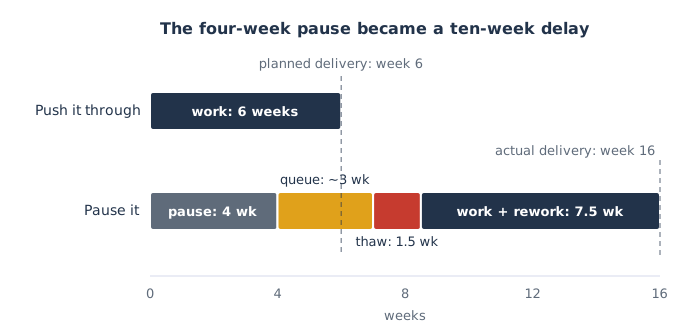
Now hold that against the alternatives the pause felt safer than. Pushing the project through its last six weeks first, then turning to the escalation, might have been cheaper if the escalation could absorb a short wait. If it genuinely could not, the honest move was not to pause this project but to kill a different one, some lower-DIPP initiative that was never going to earn out, and free the constraint that way. The pause won not because it was cheapest but because it was the option that required no one to decide anything irreversible. It felt free. It was the most expensive thing on the table.
Why the single-project view cannot see this
If the penalty is this large, why does nearly every organisation reach for the pause first?
For the same structural reason the rest of this series keeps returning to: the frame that governs the decision cannot see the cost the decision creates. Project management, as practised, tracks each project against its own baseline. A paused project has, by definition, stopped moving against its baseline, so within the single-project frame it has stopped generating variance, which is to say it has stopped being interesting. The instruments go quiet exactly when the pause penalty starts running.
But the penalty does not live inside the paused project's plan. It lives in the portfolio around it: in the drag cost accruing on a delivery date nobody is watching, in the WIP slot lengthening everyone else's queue, in the constraint that was never fully freed. This is the Project Illusion in yet another disguise, the belief that if each project is individually under control the portfolio must be healthy. A portfolio can be full of tidy, quiet, paused projects, each one perfectly under control precisely because it is not moving, and be bleeding value the whole time. A pause is not the absence of a decision. It is a decision to keep paying for a project while switching off its return, and it should be counted as one.
What to do instead
You cannot refuse to ever pause anything; genuine emergencies exist and priorities really do change. The goal is not zero pauses. It is to stop treating a pause as free, and to make it the deliberate, priced, time-boxed decision it actually is. A few disciplines do most of the work.
1. Price the pause before you take it, against the alternatives. A pause is an investment decision, exactly like acceleration. Before you freeze a project, put three numbers next to each other: the drag cost of pausing it, the cost of finishing it first, and the cost of killing something else to free the resource instead. You will often find the pause is the worst of the three. Making that comparison at all is most of the battle.
2. Pause the right project, which is rarely the obvious one. Under pressure, the project that gets paused is usually the one whose sponsor is quietest or whose team is easiest to redeploy. Neither has anything to do with economics. Never pause the project nearest the finish line: it has the least remaining investment and the most imminent value, so its DIPP is highest and its thaw cost most wasteful. Never pause the project sitting on the finishing path of your constraint. If something must stop, stop the initiative with the lowest DIPP and the most remaining constraint demand, the one that was the weakest investment anyway.
3. Prefer finishing or killing to pausing. The pause is the value-destroying middle: it keeps the drag and the thaw and the WIP while delivering nothing. Where a project has only a little work left, the cheapest thing you can usually do is push it through and bank the value, which also frees the slot for real. Where a project's economics have genuinely turned, kill it cleanly rather than freezing it, because a killed project stops costing and a paused one does not. Reserve the pause for the narrow case where the value truly is intact and the interruption truly is short.
4. If you must pause, time-box it and put a real restart cost on the plan. An open-ended pause is how a project drifts from active to zombie to quietly-dead without anyone deciding. Give every pause an explicit review date and an owner who is accountable for the frozen value, not just the frozen spend. And when you plan the restart, plan the thaw: add the re-onboarding and the re-establishment of full kit as real work, so nobody mistakes "switch it back on" for "carry on where we left off".
5. Count your paused projects as work in progress, because they are. A frozen project belongs in your WIP total and on your risk register, not in a quiet holding pen off the main board. Track how long each has been paused and how many times. A project that has spent more of its life frozen than moving is not a project you are keeping your options open on. It is a decision you keep declining to make, and the pause penalty is the interest you are paying on the indecision.
The objection you are already forming
"So you are telling me never to pause anything? The escalation was real. The constraint had to move. What was I supposed to do, ignore the client?"
No. The reframe is narrower and more useful than that. You were always going to pay a cost the moment the constraint had to move; that was not optional. What was optional was which cost, and whether you priced it. Pausing the seventy-percent-done project was one way to pay. Finishing it first, or killing a weaker project to free the engineer, were others, and at least one of them was very likely cheaper. The failure is not that you responded to a real emergency. It is that you reached for the pause because it looked free, took it without pricing it against the alternatives, and left it open-ended, so a four-week decision became a ten-week one that nobody chose.
A pause is a legitimate move. It is just not a free one, and it is not the safe default it pretends to be. Treat it as what it is, a deliberate investment decision with a drag cost, a thaw cost and a capacity cost attached, and you will take far fewer of them, take the right ones, and stop being surprised when the quietest projects on your portfolio turn out to have been the most expensive.
This is a foundations piece in the Flow Economics series. If it changed how you read the paused projects on your own board, the natural next questions are which of them still deserves to finish at all, taken up in How to Know When a Project Is No Longer Worth Finishing, and how to stop the overload that forces the pauses in the first place, which begins with Start Less to Finish More.