
The Non-Constraint Trap: Why Making Your Other Teams Faster Does Nothing
There is a team in your organisation that has just got faster, and it has made no difference to anything you deliver.
Perhaps you bought them better tooling. Perhaps you added two people, or funded the overtime, or ran the process-improvement workshop that shaved a fifth off their cycle time. The team is measurably quicker than it was last quarter, and they can prove it: their throughput is up, their backlog is down, their local numbers are green. Everyone did exactly what good managers are supposed to do, which is find a slow step and speed it up. And the portfolio, taken as a whole, is delivering at precisely the same rate it was before, or a little slower.
This is not bad luck, and it is not a failure of execution. It is arithmetic, and it is one of the most reliably counter-intuitive results in the whole of flow economics: an improvement made anywhere other than the constraint produces no additional throughput, and an improvement made upstream of the constraint often makes delivery worse. Most organisations spend a large fraction of their improvement budget learning this lesson the expensive way, one green local metric at a time. This piece is about why, and about where that money should have gone instead.
The rate of the system is the rate of one resource
Start from the single fact the whole of flow economics is built on. In any portfolio that shares a constrained resource, the pace of that one resource, the constraint, sets the delivery rate of everything. Not the average pace of all your teams. Not the pace of the busiest team. The pace of the one resource that every project must pass through and that cannot keep up with the demand placed on it.
If that is true, and it is, then a simple corollary follows that almost nobody acts on. Making a non-constraint faster cannot raise throughput, because throughput was never limited by the non-constraint. The bottleneck is still the bottleneck. You have widened a part of the pipe that was never the narrow part. The water still leaves at the rate the narrow part allows.
Goldratt put it in a sentence that is worth committing to memory: an hour saved at a non-constraint is a mirage. It feels like a gain, it shows up as a gain on the local scoreboard, and it buys you nothing at the level that matters, which is the rate value actually leaves the system. The hour was not the thing in short supply. The constraint's hour is the thing in short supply, and you did not touch it.
This is the same illusion that runs underneath The Utilisation Trap and The Efficiency Paradox, seen from a new angle. There, the error is reading a busy resource as a productive one. Here, the error is reading a faster resource as a more valuable one. Both mistake local activity for system output, and both are made honestly, by people whose local numbers genuinely did improve.
Why speeding up the wrong team is worse than doing nothing
If improving a non-constraint merely did nothing, it would be a waste of money and no more. But the case is worse than that, and the reason is where the faster team sits relative to the constraint.
Suppose the team you accelerated feeds the constraint: their output becomes the constraint's input. Design hands work to the one integration lead everything funnels through. Analysis hands work to the single specialist who signs it off. You have just increased the rate at which work arrives at a bottleneck whose rate has not changed. The work does not pass through faster. It piles up in front of the constraint, as a queue, as work in progress that has started and cannot finish.
And by Little's Law, which is not a theory but an identity, lead time rises with work in progress. A longer queue in front of the constraint means every item now waits longer to be worked. So the visible result of speeding up the upstream team is that projects take longer to get through the system, not shorter, and the portfolio feels more congested, more chaotic, harder to predict, precisely because one part of it got more efficient. You have manufactured the rework risk that comes with stale, waiting work, inflated the cost of delay on everything in the queue, and made the constraint's job harder by burying its next genuinely useful task under a heap of work it has no capacity to reach.
The team downstream of the constraint is a mirror image with the same conclusion. Speed them up and they simply wait, faster, for work the constraint is still metering out at the old rate. Their improved capacity sits idle by definition, because nothing can reach them any quicker than the bottleneck allows. The money you spent buying that capacity earns nothing, because the capacity was never the limit.
So the honest ledger on a non-constraint improvement reads: throughput unchanged, real money spent, and, if the improvement was upstream, lead time and congestion actively worse. That is not a marginal call. That is a negative return, dressed up as a local win.
A worked example
Put numbers on it, illustrative rather than precise; the shape is the point.
Take a product portfolio whose delivery all funnels through one senior systems engineer, the resource that signs off every feature before it can ship. She is the constraint, and she can clear about two features a week. Upstream of her, a design team currently produces designs at about the same rate, two a week, so work arrives roughly as fast as she can process it. Downstream, a release team can ship far faster than either. The portfolio delivers two features a week, and each feature, once live, is worth roughly £10,000 a week in avoided cost of delay.
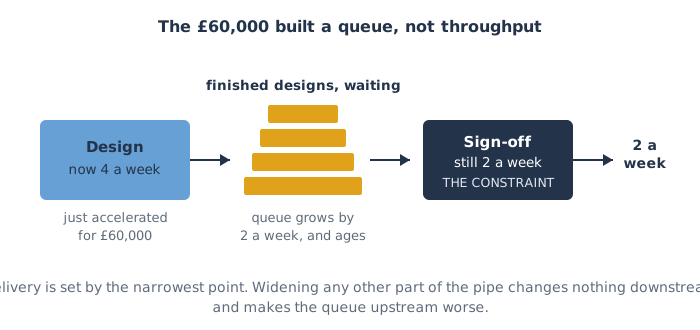
Now the improvement programme lands. Design is visibly the busiest-looking team, their backlog is the one everyone can see, so £60,000 goes into tooling and an extra pair of hands, and design capacity doubles to four a week. Local metrics are triumphant: design throughput up a hundred percent, design backlog gone.
At the system level, nothing improves, and then things get worse. The engineer still clears two features a week, so delivery holds at two. But designs now arrive at four a week and leave at two, so a queue of finished-but-waiting designs builds in front of her at two a week. After ten weeks there are twenty completed designs stacked up, aging, some now built against assumptions that have since changed and will need reworking. Lead time per feature, the wait from design-done to shipped, has stretched from a fortnight to a couple of months. The £60,000 bought negative value: no extra throughput, a longer queue, more stale work, a more congested board.
Compare the same £60,000 spent on the constraint. Suppose it funds a junior engineer to take the routine sign-off checks off the senior engineer's plate, lifting her effective rate from two features a week to three. Throughput rises by one feature a week. At £10,000 a week each and, say, a fifty-week horizon, that one extra feature a week is on the order of £500,000 of value the portfolio now captures that it did not before. Same money. One version destroys value by widening the wrong part of the pipe. The other multiplies it by widening the only part that was ever narrow.
Why single-project management is structurally blind to this
If the difference is this stark, why do organisations pour improvement money into non-constraints so consistently? Because the frame they manage in cannot see the constraint at all.
Managed as a set of independent projects and independent teams, each unit is measured against its own local efficiency: is this team fast, is its backlog short, is its utilisation high. Every one of those is a local number, and local numbers reward local improvement wherever it is cheapest and most visible to make. Nothing in the single-project, single-team frame asks the only question that matters, which is whether the team you are improving is the one setting the pace of the whole. So improvement flows, rationally within the frame and disastrously outside it, to whichever team complained loudest or measured worst, rather than to the one resource whose rate is the system's rate.
This is the Project Illusion in one of its most expensive forms: the belief that a system improves when its parts improve. It does not. A portfolio is not a collection of teams to be optimised one by one; it is a chain, and a chain does not get stronger when you thicken a link that was never going to break. The sum of local optima is not the system optimum, and an organisation that manages every team to its own local scoreboard will, with the best intentions and real budgets, spend years making the wrong links thicker. The gains are real on paper and invisible in delivery, which is exactly the signature of a cost the frame cannot price.
What to do instead
The discipline that fixes this is not complicated to state. It is Goldratt's, and it is called subordination: everything that is not the constraint should be run to serve the constraint, not to maximise its own local score. A few rules put it into practice.
1. Locate the constraint before you spend a penny on improvement. No improvement decision is sound until you can name the one resource that sets your delivery rate, by the method in How to Find the One Resource That Sets Your Delivery Speed. Every pound of improvement budget should be tested against a single question: does this raise the throughput of the constraint. If it does not, it does not raise throughput at all.
2. Spend your improvement budget on the constraint, and almost nowhere else. An hour of capacity recovered at the constraint is an hour of throughput for the entire portfolio. An hour recovered anywhere else is a mirage. So the highest-return investment in the whole system is nearly always the one that offloads, automates, protects or augments the constrained resource, exactly the logic behind ranking work by its return on the constraint. Elevate the constraint first. Then, and only then, find the new one and repeat.
3. Deliberately hold non-constraints below their top speed. This is the rule that feels most wrong and matters most. A non-constraint does not need to run flat out; it needs to run at the rate the constraint can absorb, and no faster. Releasing work upstream faster than the constraint can consume it does not speed delivery, it builds the queue that slows it. The right pace for a feeding team is the constraint's pace, which is another way of stating the work-in-progress limit that keeps the system flowing.
4. Judge every team by the constraint's flow, not by its own scoreboard. If you reward local efficiency, you will get local efficiency, in the wrong places, at the system's expense. Replace "is this team fast and fully loaded" with "is the constraint fed, unblocked and never waiting on this team." A design team that sits a little idle so the constraint is never starved is doing its job perfectly, even though its own utilisation looks poor. That is subordination working as intended, and it will feel like underperformance to anyone still reading the local numbers.
5. Never let a non-constraint starve the constraint. The one thing worse than flooding the constraint is leaving it idle for want of input. A non-constraint's real job is to make sure the constraint always has good, ready work in front of it, protected by a small buffer, so that no hour of the scarcest resource is ever lost to waiting. An hour the constraint spends idle is an hour of the whole portfolio's throughput, gone and unrecoverable, which is why the signal worth watching is buffer health, not local speed, the theme of The Watermelon Report.
The objection you are already forming
"So you are telling me to stop improving most of my teams, and to deliberately keep good people below their capacity. That is absurd. Slack everywhere, a permanent bottleneck we all just accept, and no incentive for anyone but one team to get better. How is that not a recipe for a lazy, stagnant organisation?"
It is the opposite, and the distinction is the whole point. Subordination does not say stop improving. It says improve in the order that the arithmetic dictates: fix the constraint, and when you have fixed it hard enough that some other resource becomes the limit, that new resource is now your priority. Improvement never stops; it simply always aims at the one place that can move the system, rather than spraying evenly across places that cannot. This is faster progress, not slower, because every pound of effort lands where it changes the outcome instead of where it changes only a local number.
And the "wasteful" slack on non-constraints is not laziness, it is protection. A resource held a little below its ceiling is a resource that can absorb variation, cover a wobble, and keep the constraint fed without flooding it. That is not a team failing to pull its weight. That is a team doing the one job that actually helps: making sure the scarcest hour in the system is never wasted. The stagnant organisation is not the one with slack in the right places. It is the one that made all its teams individually efficient and wondered why nothing shipped any faster.
The instinct to speed up a slow team is one of the deepest in management, and outside the constraint it is almost always wrong. Before you fund the next local improvement, find the narrow part of your pipe, and spend the money there. Everything else, however busy, however slow it looks, is a wider part of a pipe that was never the problem.
This is a foundations piece in the Flow Economics series. If it changed how you read your own improvement budget, the natural next steps are finding the resource that actually sets your pace, in How to Find the One Resource That Sets Your Delivery Speed, and understanding why loading that resource towards a hundred percent is its own separate trap, which begins with The Utilisation Trap.
Where this idea goes next
Later pieces that build on this one: